
By Gwen Rockwood, newspaper columnist and mama of 3
There’s a baby in the house. A tiny, orange, fuzzy baby with two green eyes, 18 pink toes, and 24 whiskers that are too long for his body. His name is Beanie.
Our 18-year-old daughter adopted him from a shelter during the last week of her summer break. She and Beanie will pack up and move to her college apartment later this week, but in the meantime, I get to play with the baby.
After we finished the adoption paperwork, the kind woman at the shelter handed us a cardboard carrier containing the two-pound kitten. Judging from the mournful meows coming from the box, the baby hated the 20-minute car ride to our house. Once we arrived, he crawled under the sofa and decided it was a safe cave. At just 9 weeks old, Beanie had spent nearly his entire life in a small cage at a shelter, and suddenly we’d set him down in a huge room with things he’d never seen before. We lured him out with a few cat treats, and he crept slowly around the room — wide-eyed and hesitant, as if he’d just landed on the moon.
Thankfully, babies are quick learners. After a half-hour of quiet exploration and cautious sniffs, the kitten decided this moon landing wasn’t so bad after all. He began crawling over our laps and scampering around the room, squeezing under or climbing over every obstacle along the way.
By Day 2, Beanie was happily investigating, pouncing on and playing with nearly everything. He can turn even a stray piece of fuzz into a fascinating cat toy, batting it with his tiny paw to send it sliding across the floor like a hockey puck. And he has become so attached to Kate that he climbs her like a tree anytime she walks into the 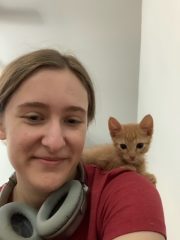 room. He then perches on her shoulder like a parrot and often falls asleep there, draped across her neck like an orange-striped scarf.
Since the settling-in process was going well, we moved on to Phase 2 — introducing the new kitten to the dog. This is where things got tricky. We weren’t too worried about the dog’s reaction because we know him so well. Kate’s Goldendoodle, Mac, is a service dog with years of specialized training. We’d already seen him around a cat and knew he wouldn’t be aggressive. The thing we couldn’t predict was how a two-pound kitten would react to a 90-pound dog — the first dog he’s ever seen in his nine weeks of life.
Mac had spent most of that first day waiting patiently outside the door of the room we’d set up for the kitten’s transition. Every time we came out of the room, he’d sniff our clothes to assess the new baby smell, and we rubbed his head to tell him he was going to be a good big brother. When Kate thought the kitten was ready, I put a leash on Mac and led him slowly into the room.
Beanie froze when he saw the blonde, curly-haired creature standing tall on four long legs. I told Mac to sit so the two of them could look at each other from across the room. We did several short “exposure therapy” sessions like this over the next few days. During each session, Kate and I sit on the floor between the kitten and dog, praising Mac for lying still while Beanie the Baby tip-toes around him to investigate. Sometimes he gets spooked and arches his back before retreating to the safety of his under-couch cave.
Other times, he calmly watches Mac from a short distance away, eyeing the dog’s swishing tail with amazement. Sometimes he reaches out one tiny paw as if he wants to touch this gentle giant, but he’s not yet sure it’s a good idea.
Time is the most important part of this transition, and we know constant supervision will be critical for the next several months. But I have a good feeling about these two. As Humphrey Bogart once said at the end of Casablanca, “I think this is the beginning of a beautiful friendship.”
Gwen Rockwood is a syndicated freelance columnist. Email her at gwenrockwood5@gmail.com. Her book is available on Amazon.